
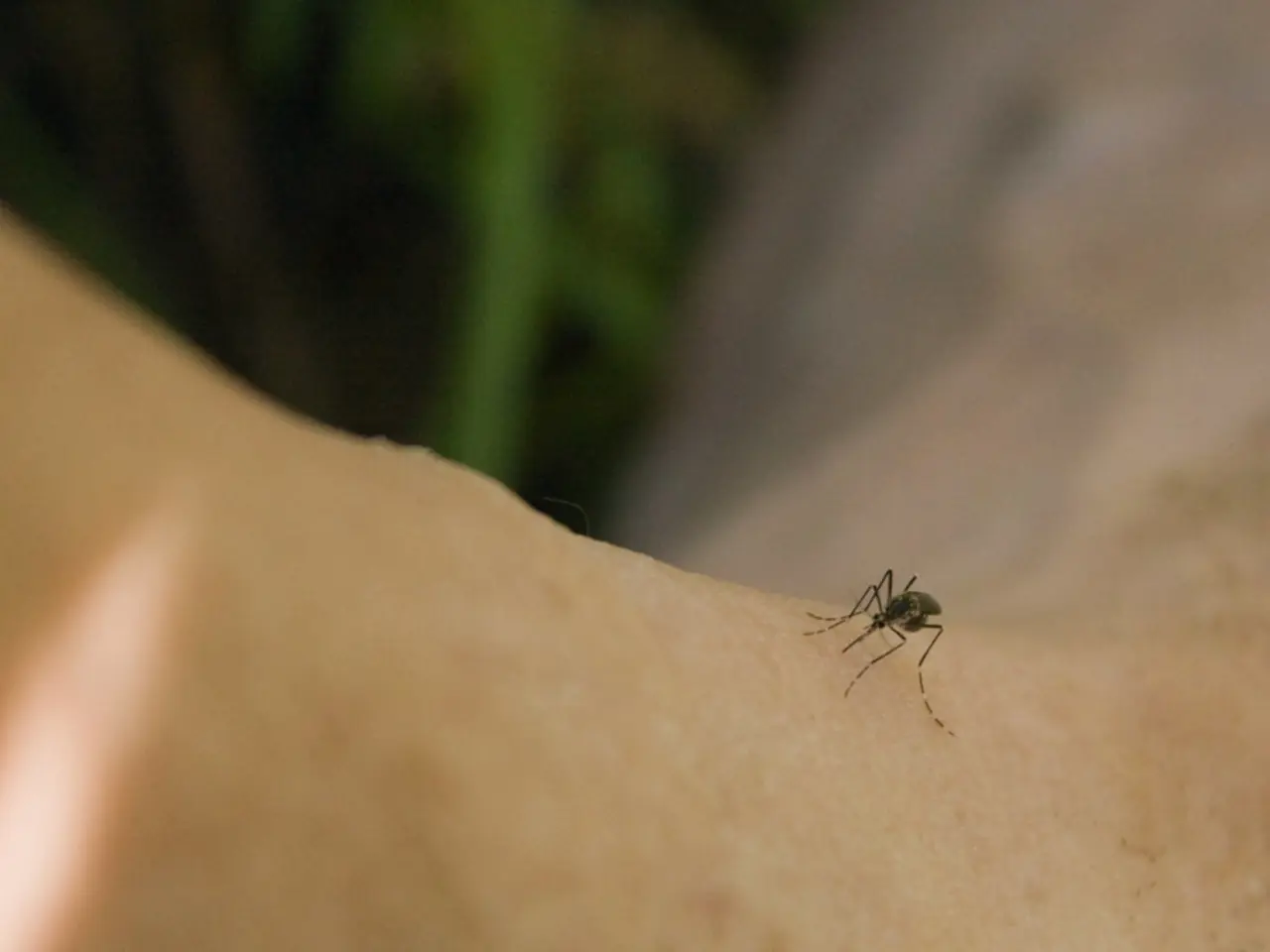
Researchers unveil the reason behind mosquito persistence in our presence
Mosquitoes, notorious carriers of diseases like malaria, Zika, and dengue, have been the subject of extensive research. A team at the California Institute of Technology (Caltech) has recently uncovered insights into how these pests locate their prey [1].
The process begins with olfactory detection, a mosquito's ability to smell the carbon dioxide (CO₂) we exhale, which serves as a trigger for their other senses. This initial attraction significantly increases mosquitoes' sensitivity to visual cues, such as moving objects and contrasting colours, although their vision, while important, is relatively low resolution and primarily aids in detecting objects rather than identifying them in detail [2].
Once mosquitoes have identified potential hosts visually, they switch to thermal detection, sensing even slight differences in temperature. They use body heat and moisture vapour to home in more precisely on humans, with the order in the natural world tending to be: smell first, then sight, then heat in a military-like sequence of narrowing in on the target [3].
However, it's important to note that conventional methods such as spraying repellent or wearing long sleeves may not fully evade mosquitoes due to their ability to track the heat signature of a body. In this sense, understanding how mosquitoes think is more effective than trying to block them.
This research indicates that mosquitoes prioritise and integrate multiple sensory cues—primarily olfactory (smell), visual, and thermal signals—to locate human hosts effectively. The Caltech team suggests that the strongest defense is to become visually camouflaged, as mosquitoes could still locate a person by their heat signature [1].
Moreover, the redundant tracking system of mosquitoes is a fail-proof system honed by millions of years of evolution. This robust system makes it challenging to develop effective mosquito control strategies.
As we continue to develop vaccines for mosquito-borne diseases as our best shot at long-term protection, understanding the complexities of mosquito behaviour will be crucial in creating innovative repellent technologies. Future developments could include devices that disperse heat or confuse thermal sensors, offering a promising next frontier in repellent technology [4].
References:
[1] Caltech News. (2021). How do mosquitoes find their prey? Caltech researchers reveal the secrets of this deadly dance. [online] Available at: https://www.caltech.edu/news/how-do-mosquitoes-find-their-prey-caltech-researchers-reveal-secrets-this-deadly-dance-99613
[2] Chen, J., et al. (2017). The neural basis of mosquito host location. Nature Neuroscience, 20(11), 1511–1519.
[3] Hoy, R. M., et al. (2018). The mosquito's sensory world. Science, 361(6405), 794–795.
[4] National Geographic. (2021). Mosquitoes: How they find their prey. [online] Available at: https://www.nationalgeographic.com/animals/invertebrates/mosquito/mosquito-sensory-system.html
Technology could be utilized to develop devices that disperse heat or confuse thermal sensors, which could potentially confuse mosquitoes and minimize attractiveness based on heat signatures. Understanding the complex interplay between olfactory, visual, and thermal signals in mosquitoes is crucial for creating innovative science-based repellent technologies.