
Intense evaporation induced by condensation strips significantly contributes to climate disruption
In the skies above Europe and the Atlantic, air traffic controllers are faced with a delicate challenge: the tight airspace and the potential domino effects of changes to original flight plans. This is due to the significant climate impact of aircraft contrails, which, despite contributing less than 3% of all flights, are responsible for 80% of the climate-damaging contrails, particularly over the North Atlantic [1].
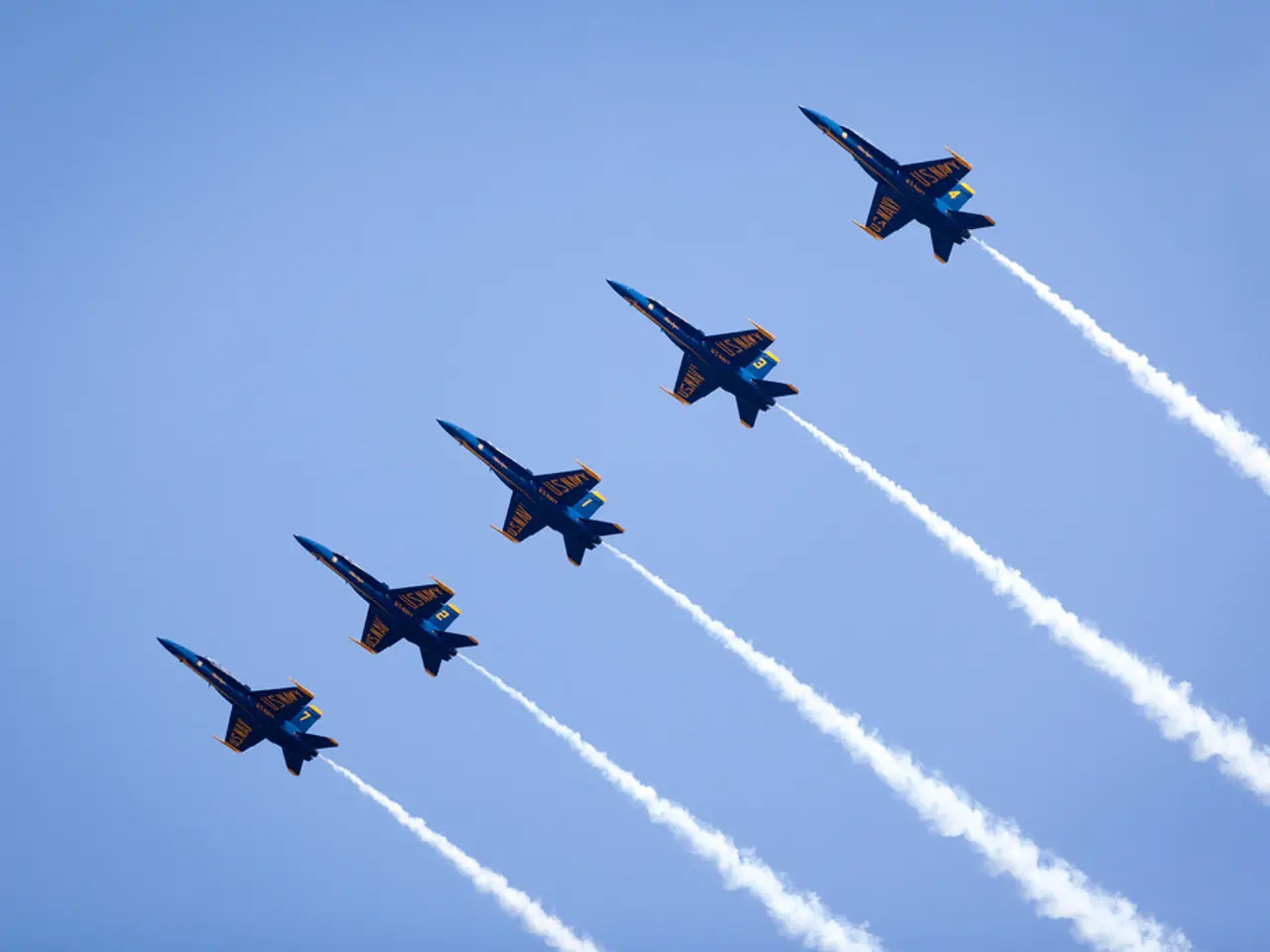
Contrails are formed when hot engine exhaust mixes with cold, moist air at high altitudes, leading to the formation of ice crystals [4]. While some contrails may reflect sunlight and have a cooling effect, the majority, especially those that persist and spread (so-called "persistent contrails"), trap outgoing heat, contributing to global warming [2].
To tackle this issue, a combination of scientific understanding, operational strategies, and technological innovations is required. The European Union has taken a step forward by requiring European airlines to record and report the non-CO2 effects of their European flights since the beginning of the year [3].
## Understanding Contrails and their Climate Impact
Understanding the factors influencing contrail formation and their climate impact is crucial. Research suggests that the climate impact of contrails depends on several factors, including the time of day, season, and geographical position of the aircraft [4]. During the night, contrails trap warm air masses in lower air layers, which is particularly harmful to the environment. During the day, they can shield the Earth from solar radiation [4].
## Strategies to Minimize or Avoid Contrails
### Flight Path Optimization and Altitude Adjustment
Modest altitude adjustments—often within 2,000 feet—can help aircraft avoid ice-supersaturated regions where contrails are likely to form, keeping fuel penalties minimal while significantly reducing contrail formation [4].
### Predictive Modeling and Real-time Decision Support
Improved predictive models use meteorological data to identify and map ice-supersaturated regions, allowing airlines to reroute flights away from areas likely to create persistent contrails [4]. Tools like Google’s Project Contrails use machine learning to automatically detect contrails in satellite images and optimize flight trajectories to avoid contrail formation [4].
### Alternative Fuels and Engine Technologies
Cleaner-burning fuels can reduce both CO₂ emissions and contrail ice crystal formation, offering a dual benefit for climate impact mitigation [2]. Advances in engine technology may help reduce the amount of soot and other particles in engine exhaust, which are key to forming ice crystals in contrails.
### Targeting the "Big Hit" Flights
Since only a small fraction of flights account for most of the contrail-induced warming, targeted mitigation strategies can focus on flights most likely to create impactful contrails [3].
## Challenges and Trade-offs
Some mitigation strategies, particularly those involving altitude or route changes, may slightly increase fuel consumption or flight times, but the overall penalty is generally modest [4]. Balancing air traffic control capacity and congestion in contrail-free airspace is also crucial when rerouting flights to avoid contrails [4].
## Integrated Approach
An integrated approach, combining flight path optimization, advanced forecasting, use of sustainable fuels, and targeted mitigation, offers the most effective way to minimise the climate impact of contrails in the near to medium term [2][4]. The aviation sector can significantly reduce the climate impact of contrails without major disruptions to current practices [2][3][4].
[1] German air traffic control (DFS) warns of tight airspace and increased coordination workload due to changes in flight plans. [2] The EU wants to integrate non-CO2 effects into the existing CO2 emissions trading system, potentially burdening European airlines in competition with providers from Turkey or the Arab region. [3] Only 3% of all flights are responsible for 80% of the climate-damaging contrails, primarily over the North Atlantic. [4] Contrails are particularly long-lived and can develop into artificial cirrus clouds mainly at high altitudes of at least ten kilometers, the usual cruising altitude of commercial aircraft.
- The European Union's requirement for European airlines to record and report the non-CO2 effects of their flights, such as contrails, is a part of a community policy aimed at minimizing the climate impact of aviation.
- Given the significance of small and medium-sized undertakings in the aviation industry, it's essential to integrate environmental-science research, particularly in regards to persistent contrails and their impact on climate-change, into business strategies and technological innovations.
- As finance and energy play crucial roles in the aviation sector, investing in cleaner-burning fuels and advanced engine technologies can contribute to both reducing CO2 emissions and the formation of contrails, offering a dual benefit.
- Operational strategies, like flight path optimization, altitude adjustment, and predictive modeling, are essential tools for small and medium-sized undertakings to minimize or avoid persistent contrails, thereby reducing their contribution to energy consumption and climate-change.