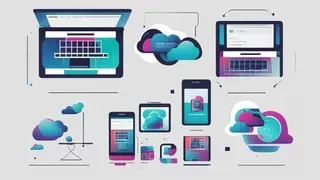

Exploring the Future Dynamics of Human-Machine Interface (HMI) and Supervisory Control and Data Acquisition (SCADA) Evolution
In the world of industrial operations, a significant shift is underway. The integration of Artificial Intelligence (AI) into predictive maintenance and anomaly detection is becoming a growing trend, transforming the way industries operate.
This transformation is driven by the adoption of hybrid models that combine on-premises edge computing with cloud services. These models enable real-time equipment monitoring through the analysis of temperature and vibration data, enabling predictive maintenance.
Manufacturers are integrating smart sensors, energy meters, and wireless transmitters into Human-Machine Interface (HMI)/SCADA platforms for real-time equipment monitoring. This integration enhances the capabilities of predictive maintenance, allowing anomalies in temperature and vibration data to be detected earlier, reducing the likelihood of costly downtime.
The hybrid models are supported by open communication standards like MQTT and OPC UA for vendor-neutral data exchange. This ensures compatibility across different manufacturers' equipment, fostering a more connected industrial landscape.
HMIs are evolving to resemble consumer devices with touchscreen interfaces, gesture controls, and voice commands. These advancements aim to improve the efficiency and reliability of industrial operations by providing a more user-friendly interface for operators.
The use of AI applications for predictive maintenance and anomaly detection is expanding, and these advancements are aimed at further improving the efficiency and reliability of industrial operations.
At the heart of this evolution is the current state and evolution of hybrid edge-cloud computing models in industrial automation. These models, characterized by integrated distributed architectures, combine real-time local processing at the edge with expansive cloud capabilities.
Standardized data exchange increasingly relies on OPC UA, a widely adopted industrial communication standard. This enables secure, consistent data flow between edge devices and cloud systems, facilitating real-time control and enhancing latency-sensitive operations like predictive maintenance and AI-based control loops.
Together, these innovations form a continuous digital thread from the shop floor to the enterprise cloud, enabling smart automation that is scalable, secure, and adaptive to Industry 4.0 demands.
- The integration of smart sensors, energy meters, and wireless transmitters into HMI/SCADA platforms, driven by edge computing, contributes to real-time equipment monitoring and enhances predictive maintenance in the manufacturing industry.
- The adoption of hybrid edge-cloud computing models in industrial automation facilitates standardized data exchange using open standards like MQTT and OPC UA, which enables secure, consistent data flow for real-time control and latency-sensitive operations.
- The evolution of technology in the industry includes the advancement of HMIs to resemble consumer devices, with touchscreens, gesture controls, and voice commands, aiming to improve efficiency and reliability in predictive maintenance and other operations.
%20and%20Supervisory%20Control%20and%20Data%20Acquisition%20(SCADA)%20Evolution)