"Aero-Inspired Shark Skin Coating Implemented on Lufthansa Aircrafts - Emulating Nature's Efficiency"
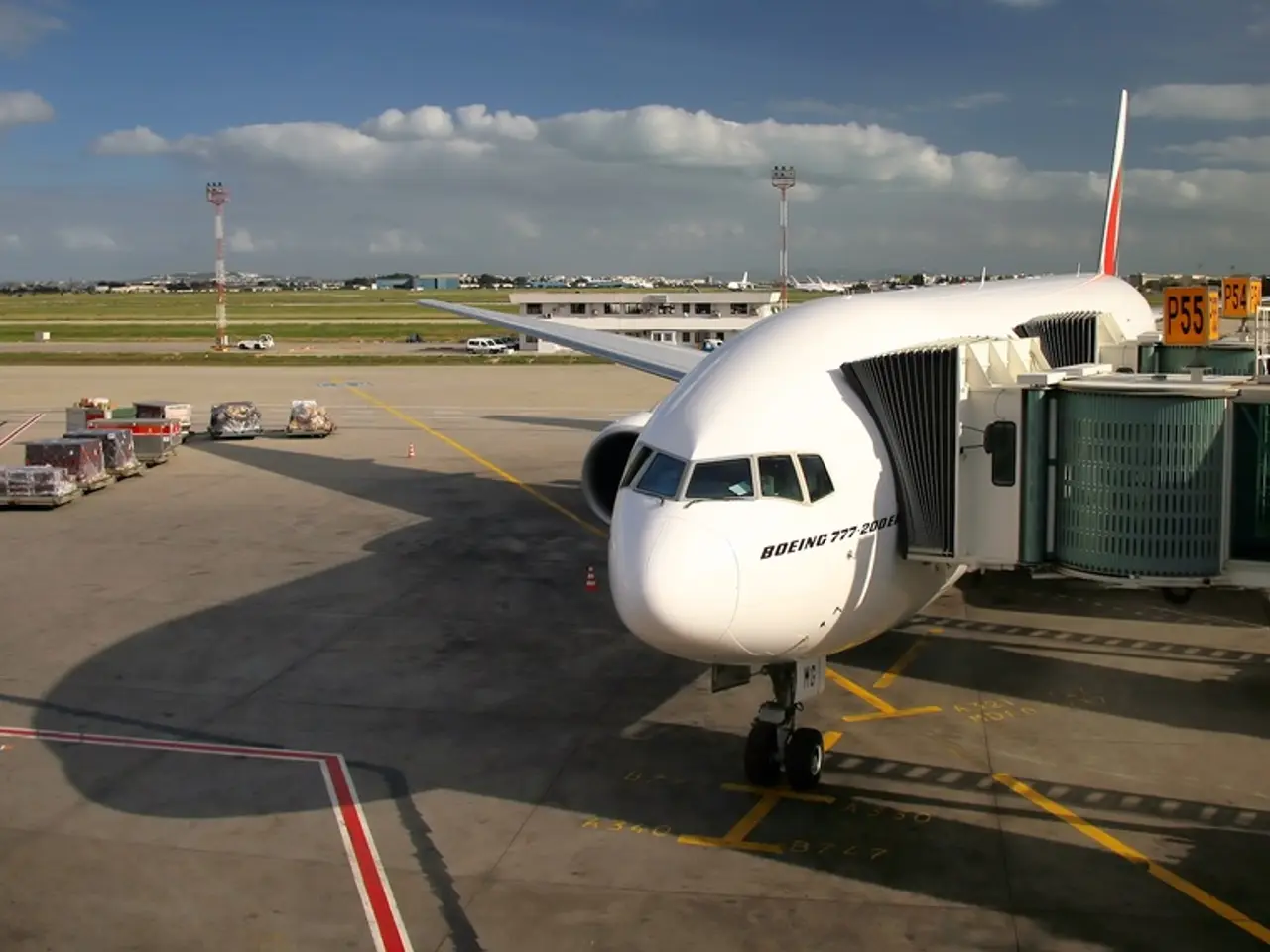
Lufthansa Cargo has taken a significant step towards reducing its carbon emissions by covering its Boeing 777F cargo planes with a special material called AeroSHARK. This innovative coating, developed in collaboration with Lufthansa Technik and chemical giant BASF, has proven to be efficient and weather-resistant after 1,500 flight hours of observation.
The AeroSHARK product is designed to reduce friction on the fuselage of the aircraft during flight, resulting in substantial fuel savings. According to estimates, Lufthansa's 10-aircraft Boeing 777F fleet is expected to achieve annual fuel savings of approximately 3,700 tons. This reduction corresponds to a significant decrease in carbon emissions, as reduced fuel consumption directly lowers CO2 output.
The technology's adoption contributes to Lufthansa Group’s broader sustainability goals in reducing aviation emissions. The AeroSHARK technology, inspired by shark skin, reduces frictional resistance on an aircraft’s surface, thereby improving aerodynamic efficiency. While specific percentage reductions for Lufthansa's fleet are not directly stated, similar applications on Boeing 777 aircraft by other airlines such as ANA report about a 1% reduction in fuel use and CO2 emissions.
The AeroSHARK materials, produced by BASF, are designed to be resistant to all weather conditions and easy to apply, making it convenient for Lufthansa's maintenance team. It is aimed to cover all cargo aircraft in the Lufthansa fleet with the AeroSHARK product starting from the beginning of 2022. Aircraft surfaces are exposed to high levels of UV radiation, temperature, and pressure changes at high altitudes, which the AeroSHARK materials are designed to withstand.
In trials towards the end of 2019, a portion of a Boeing 747-type aircraft was covered with the AeroSHARK material, spanning approximately 500 m2. The efficiency and weather resistance of the AeroSHARK product have been observed and confirmed over these flight hours. The development of the AeroSHARK product is part of Lufthansa's goal of achieving carbon-neutral flights by 2050.
Here's a summary of the key metrics for Lufthansa Cargo's Boeing 777F fleet:
| Metric | Estimate for Lufthansa Cargo Boeing 777F fleet | |------------------------------|------------------------------------------------------------| | Fleet size | 10 Boeing 777F aircraft | | Annual fuel savings | ~3,700 tons of fuel | | Approximate fuel saving rate | Around 1% fuel reduction based on comparable Boeing 777 data[1] |
This technology’s adoption is a significant step towards Lufthansa's commitment to reducing emissions and achieving carbon-neutral flights.
Note: The direct source for Lufthansa Cargo’s fuel savings is in Japanese, but translates to about 3,700 tons of fuel saved annually for the entire 777F fleet of 10 aircraft[4]. The percentage fuel saving corresponds closely to what ANA has documented on similar planes fitted with the AeroSHARK coating[1].
The significant fuel savings achieved by Lufthansa's Boeing 777F fleet, estimated at approximately 3,700 tons annually, equates to a substantial reduction in carbon emissions, contributing to the industry's efforts to combat climate change. The technology's 1% fuel reduction, as observed in similar aircraft, places Lufthansa in the forefront of finance and energy-efficient aviation technology.